UCCA Beijing Open Today, 10:00-19:00 (Final entry: 18:30)
UCCA Dune Open Today, 9:30-19:30 (Final entry: 19:00)
UCCA Clay Open Today, 9:00-18:00 (Final entry: 17:30)
UCCA Dune
Yang Xinguang: Dark Surfaces
2026.4.19 - 2026.10.11
About
From April 19, 2026, to October 11, 2026, UCCA Dune presents “Yang Xinguang: Dark Surfaces,” the artist’s largest institutional solo exhibition to date in terms of scale and number of commissioned artworks. Featuring more than ten new sets of work spanning installation, sculpture, video, and site-specific interventions, the exhibition draws on the ecological concept of the “litter layer” to construct a contemporary allegory of material transformation, human intervention, and otherness. Set within the museum’s cave-like architecture, the works appear as specimens suspended beyond natural cycles to prompt reflection on humanity’s position within the natural world.
From April 19, 2026, to October 11, 2026, UCCA Dune presents “Yang Xinguang: Dark Surfaces,” the artist’s largest institutional solo exhibition to date in terms of scale and number of commissioned artworks. Staged across UCCA Dune’s cave-like galleries and outdoor spaces, the exhibition brings together more than ten new works, including installations, sculpture, video, and site-specific interventions. Over the past two decades, Yang Xinguang has consistently worked with natural materials such as stone, wood, soil, and plants as both media and subjects. He has also employed steel, concrete, and paint as active counterpoints to the aforementioned materials, developing his own distinctive visual language and conceptual approach. The exhibition marks a further articulation of a long-standing concern in his practice—namely, the process of natural decay and the human interventions enacted upon it—rendered here in a more systematic, contextualized, and contemplative form. This exhibition is curated by UCCA Chief Curator Chelsea Qianxi Liu.
The exhibition title “Dark Surfaces” draws on the ecological concept of the “litter layer,” the stratum of decomposing leaves, branches, and plant and animal remains that covers the earth’s surface. Concealed beneath vegetation—cool, damp, and dim—this seemingly inconspicuous layer is a critical component of healthy ecosystems: the site where death transforms into new life, sustained by dense microbial activity and complex spatial stratification. For Yang Xinguang, as one of the interfaces where human activity most directly meets the natural world, “dark surfaces” denote a framework of layered metaphor as well as a concrete, physical condition of the earth.
Beginning from this shadowy threshold, the exhibition examines how human emotion, creativity, and aesthetic intention take shape within the natural world. Through interventions that imitate, interrupt, or suspend natural life cycles, Yang renders natural materials into “Others” outside ecological circulation. A central question follows: are human actions integral to natural order, or do they constitute a presence that resists assimilation? Appearing as specimens sealed beyond cycles of regeneration, the works present a contemporary allegory of the imposition of human systems upon the natural world.
The interconnected, cave-like architecture of UCCA Dune, with its cellular-like spatial structure, frames the exhibition and guides visitors from the earth’s surface into its depths, and from everyday perception toward broader questions of existence. The newly commissioned work Suspension (2026) is embedded within the surrounding vegetation: stainless steel rods, whose reflective surfaces blend into their surroundings, support clusters of river stones that appear to defy gravity. This subtle intervention into natural order is both precise and charged with tension: held in a liminal state, the stones become heterogeneous presences that belong neither to sky nor earth.
In Gallery 1, visitors encounter Soil (2026), a work that addresses the primitive yet transformative realm of soil, the source from which life emerges. Using branches, soil, and glutinous rice paste, the artist forms objects resembling chairs, stools, beds, and cushions that oscillate between furniture and sculpture. Their surfaces are coated in soil and appear to bear traces of use, as if weathered over time. Here, soil functions simultaneously as material and subject, pointing to processes of decay and regeneration at the core of the “dark surfaces.” Through these elemental works, an intimate relationship is reestablished between humanity and the earth.
In the central gallery stands large-scale installation Extra Beauty (2026). A series of steel rebar structures, approximately 3.8 meters high, spiral into branching sequences, enclosing ceramic fruit-like sculptures. One of the most rigid and utilitarian materials of urban construction, here rebar is rendered as vine-like and flexible, intertwining with the ceramic “fruit” to evoke the strangler fig growth pattern found in tropical rainforests. A striking visual tension emerges between structural rigidity and bodily softness.
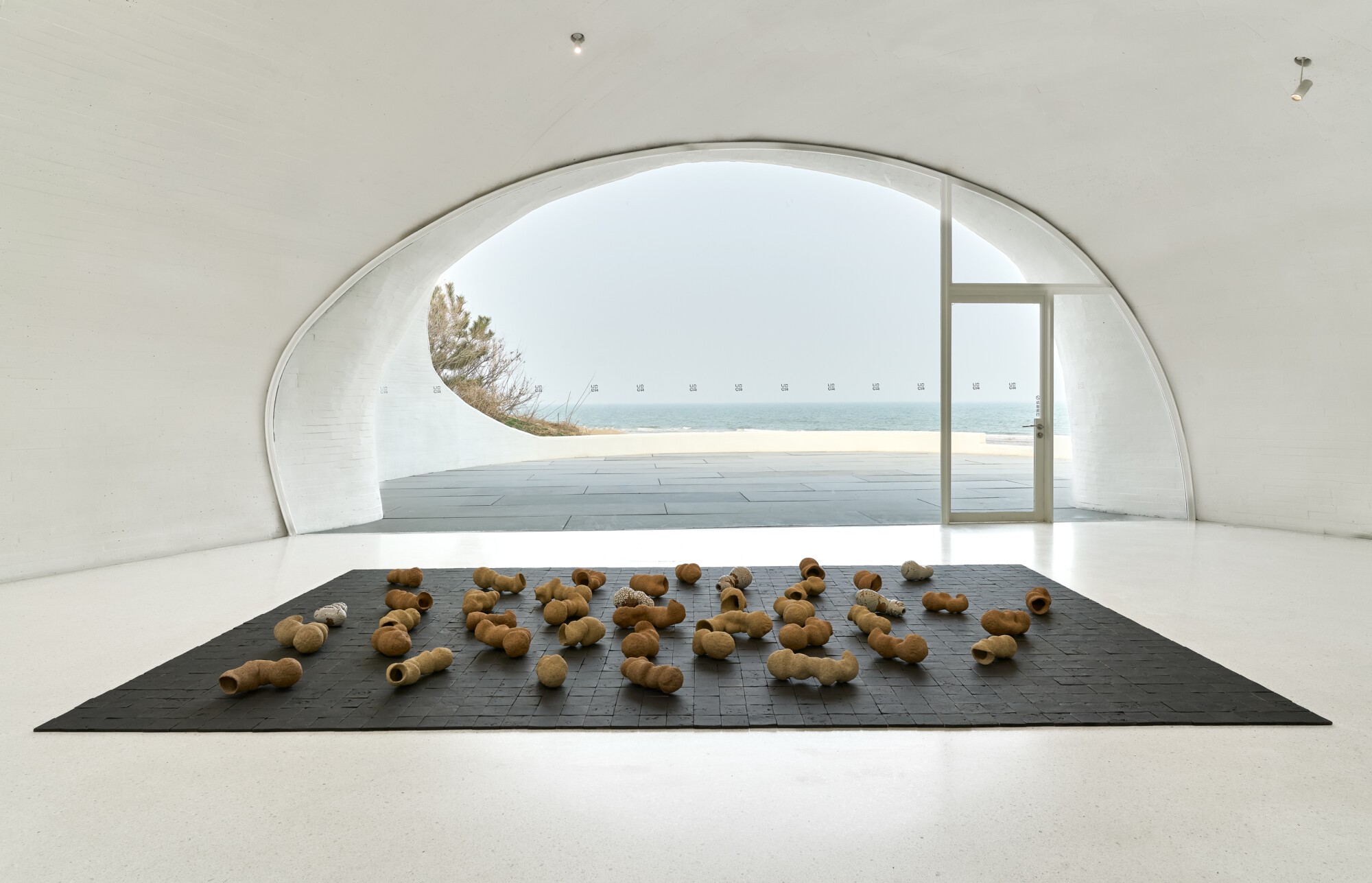
Clay Nests (2026) takes the concealed micro-architecture of the “litter layer”—namely that of insect nests—and expands it in scale. Using clay, the artist reconstructs hollow, interior cavities and places them on black brick surfaces. The forms resonate with the museum’s cave-like structure while shifting “darkness” from a descriptive quality into an inhabitable spatial condition, pointing to the dense, largely invisible networks of life beneath the earth’s surface.
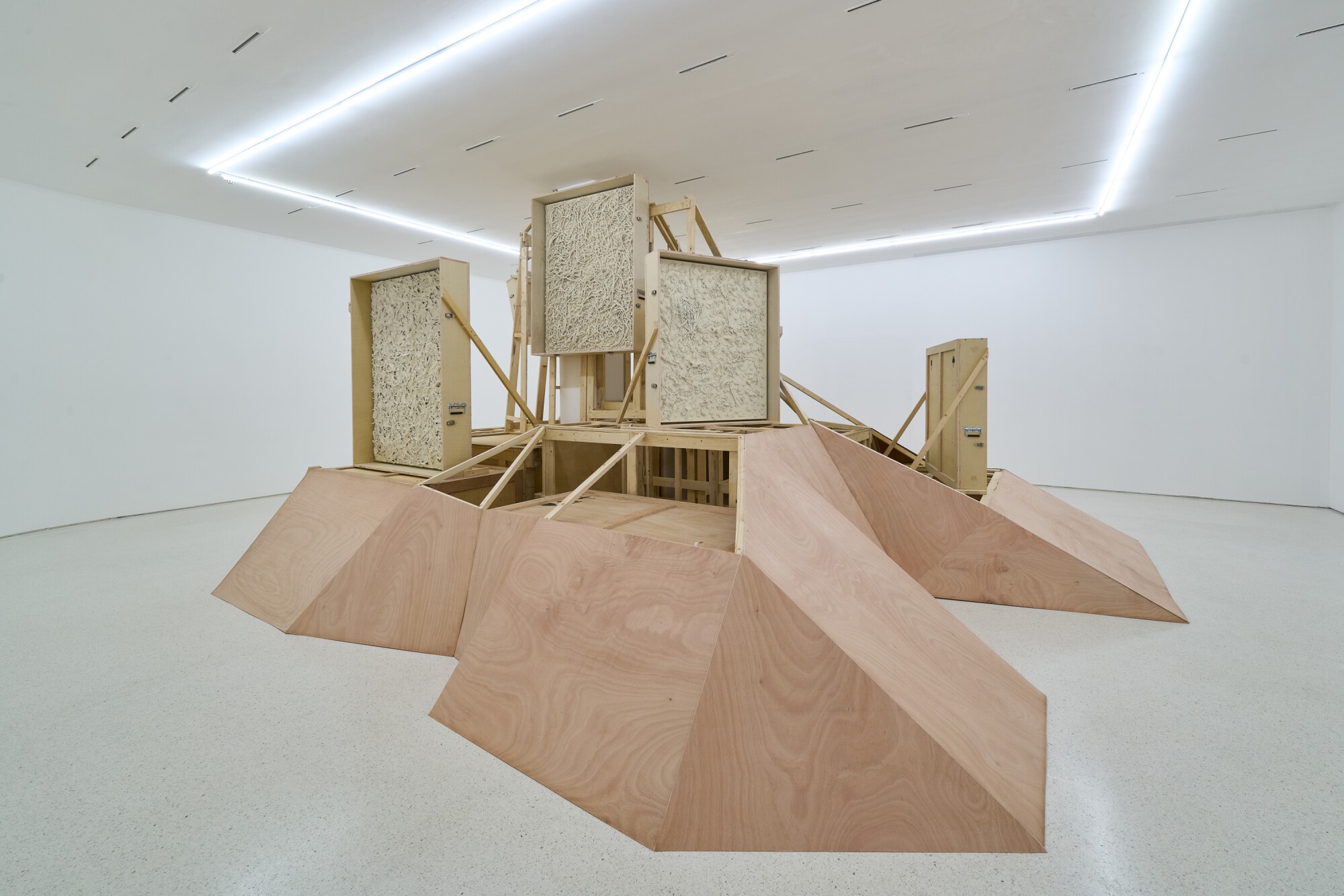
Monumental Botanics (2026) and On the Ground (Camouflage) (2026) form a critical dialogue on preservation and concealment. In the former, large quantities of fallen leaves are coated in successive layers of paint until they become smooth, rounded “plant mummies,” which are then stacked together with wooden packing crates to form a monument. The monumental structure lends weight and visibility to otherwise insignificant organic matter, while also exposing a central tension of preservation: to commemorate nature is to interrupt its cycles of decomposition and regeneration, foreclosing their potential for transformation and the emergence of new life.
In the latter work, leaves saturated with pigment are laid across camouflage fabric, revealing the latent logic of control embedded in human interventions into nature. Originally developed as a military device for concealment through imitation of natural patterns, camouflage here produces the opposite effect: the painted leaves become more visually pronounced. Disguised as artificial material, they lose the ability to decompose and return to soil, while the camouflage fabric substitutes for the ground itself, forming an artificial “litter layer” detached from ecological cycles.
The exhibition further extends perceptual boundaries through video and sound. Grass Spike (2026) and Dust (2026) turn their gaze to ephemeral matter carried by the wind, capturing fleeting moments in which disappearance is briefly held as permanence. In Lofty Scholars (2026), Yang offers an experimental re-reading of Chinese literati tradition. Departing from the classical image of the recluse-poet withdrawing into mountains to compose verse, the artist and a friend instead perform improvised vocal exchanges imitating the calls of wild animals. This seemingly “regressive” gesture reflects an attempt to shed cultural discipline and reestablish a more elemental connection with the natural world—while also revealing the inherent estrangement and absurdity that arise when human subjects immerse themselves in nature and its logics.
Moving into the outdoor areas where UCCA Dune meets the surrounding landscape, the exhibition extends into open-air sites of encounter. On the terrace, Detritus (2026) invites audience participation: visitors may place plant matter they gather into biomorphic clay vessels, producing an open-ended collective composition. This everyday act of interaction subtly reveals how interruptions to natural decomposition often emerge from the most ordinary of human impulses.
Along the beach, the “Warriors” series (2023) unfolds as a durational experiment in time. These “soldiers,” constructed from rebar skeletons filled with organic matter, stand exposed along the shoreline. Over the course of the exhibition, wind and tides shall gradually erode their organic interiors, leaving only the hollow steel armatures. This process transforms the works into time-based structures, bringing the question of decomposition into lived reality: human-imposed forms and meanings are ultimately absorbed by natural cycles, leaving behind only the skeletal trace of industrial structures as a fragile record of presence.
Ultimately, “Dark Surfaces” transforms the entanglement humans and nature into a sustained inquiry into decomposition and the heterogeneity of identity. Through soil, steel, and organic matter caught in the act of dispersal, Yang Xinguang, by artistic intervention, explores the rupture of constructed order and natural cycles. As form returns to earth and emptiness, the exhibition leaves open a question regarding existence: within the depths of dark surfaces, might humanity be able to rediscover a humbler way of living?
Support and Sponsorship
Exclusive wall solutions support is provided by Dulux, and Genelec contributed exclusive audio equipment and technical support. UCCA also thanks the members of UCCA Foundation Council, International Circle, and Young Associates, as well as Lead Partners Aranya and The Donum Estate, Lead Art Book Partner DIOR, Presenting Partner Bloomberg, and Supporting Partners AIA, Barco, Dulux, Genelec, SKP Beijing, Stey, and Wanbo Media Group.
Public Programs
Public Programs for the exhibition “Yang Xinguang: Dark Surfaces” include an opening guided tour, a workshop, and a conversation. Centered on the artist’s practice, which engages soil, plant matter, and processes of transformation, the programs consider his work through the lenses of material intervention, sculptural language, and ecological thinking, inviting audiences to move between observation, participation, and critical reflection.
The Opening Guided Tour, led by the artist and curator, will guide audiences through the exhibition at UCCA Dune, introducing key works and their spatial relationships within the presentation as a whole. Particular focus will be given to site-specific installations, considering how they are shaped through direct engagement with architectural conditions and the surrounding environment. The tour will be followed by the workshop Surface Exercises, in which participants will work with natural materials—stones, branches, dried leaves, and soil—to create small sculptural forms through processes of assembly, shaping, and coloring. The workshop foregrounds the materials’ inherent properties and their responsiveness to context, inviting a hands-on exploration of form-making beyond industrial frameworks.
During the exhibition period, the conversation will take the artist’s practice as a point of departure to examine broader questions around ecology, species, and the concept of “nature.” Bringing together perspectives from art and the natural sciences, the conversation will explore how acts of material intervention disrupt or reconfigure processes of growth and decay, and how such gestures reflect contemporary understandings of the relationship between humans and the natural world.
About the Artist
Yang Xinguang (b. 1980, Hunan, China; lives and works in Beijing) received his BA in Sculpture from the Central Academy of Fine Arts, China, in 2007. His works have been featured in many museums and institutions, such as UCCA Center for Contemporary Art, Beijing; UCCA Dune, Beidaihe; Nazionale D’Arte Moderna e Contemporanea, Rome; The National Gallery of Georgia, Tbilisi; White Rabbit Museum, Sydney; FRAC des Pays de la Loire, Nantes; Singapore Art Museum; Lehmbruck Museum, Duisburg; Power Station of Art, Shanghai; Asia Culture Center, Gwangju; and M+, Hong Kong.
Yang has received many awards, including the 2010 Chinese Contemporary Art Golden Palm and the Nomination Award of the 2010 Wu Zuoren Art Awards. He has also been nominated for 2015 HUGO BOSS Asia Prize, the 2014 Award of Art China, the 2nd Huayu Youth Award (2014), and the 2011 Signature Art Prize. His works are in the collections of institutions including the Fosun Art Foundation, Shanghai; Long Museum, Shanghai; M+, Hong Kong; Kadist Art Foundation, Paris and San Francisco; FRAC des Pays de la Loire, Nantes; 33 Contemporary Art Center, Guangzhou; Shanghai Museum of Glass; De Heus Collection, The Netherlands; G Museum, Nanjing; White Rabbit Museum, Australia; and DSL Collection, France, among others.
About UCCA Dune
UCCA Dune is an art museum buried under a sand dune by the Bohai Sea in Beidaihe, 300 kilometers east of Beijing. Designed by OPEN Architecture, its galleries unfold over a series of cave-like spaces. Some are naturally lit from above, while others open out onto the beach. UCCA Dune presents rotating exhibitions in dialogue with its unique site and space, with a particular focus on emerging Chinese and global talents. Opened in 2018, UCCA Dune is supported by UCCA strategic partner Aranya, the seaside cultural and lifestyle community where it is located.
UCCA Beijing
Open Today, 10:00-19:00 (Final entry: 18:30)
798, No. 4 Jiuxianqiao Lu, Beijing
Tel: +86 153 1170 8837
UCCA Dune
Open Today, 9:30-19:30 (Final entry: 19:00)
Aranya Gold Coast, Beidaihe
Tel: +86 335 7522 652
UCCA Clay
Open Today, 9:00-18:00 (Final entry: 17:30)
West Entrance, Creative & Cultural Ceramic Avenue, Dingshu Town, Yixing City, Wuxi City, Jiangsu Province
Tel: +86 0510 8767 9989